
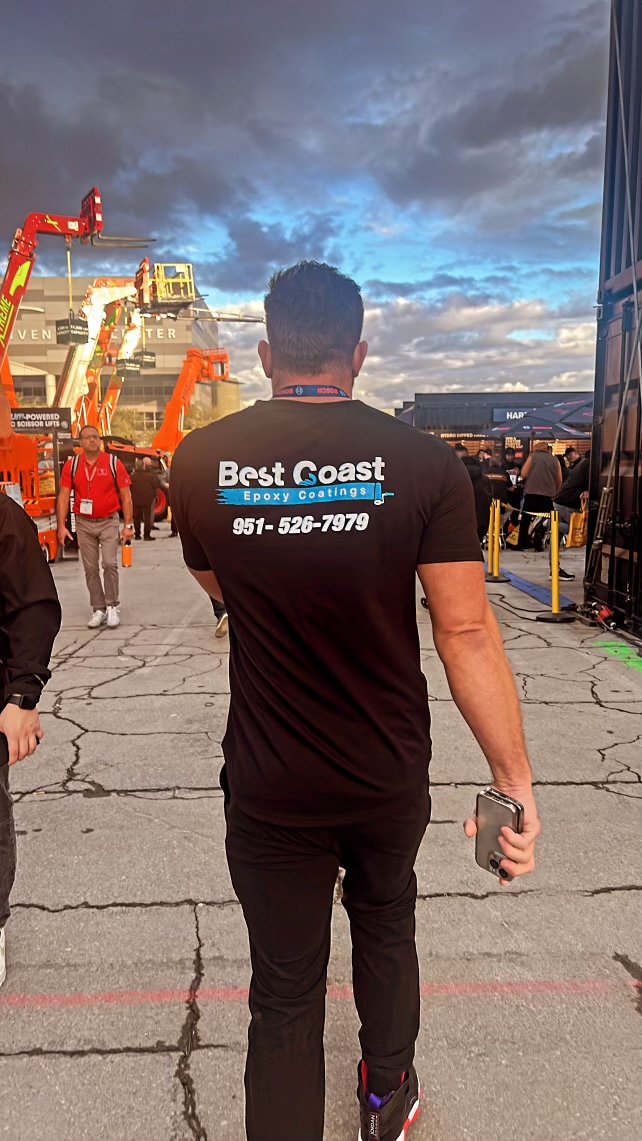
Ryan Pepple, Founder and Lead Installer at Best Coast Epoxy Coatings
Ryan Pepple has installed epoxy and polyaspartic floor coatings by hand since 2011. He built Best Coast Epoxy Coatings from one truck in Southern California into a company with thousands of completed floors, and he now runs it from Franklin, Tennessee, where he still tests, quotes and signs off on every slab.
Fifteen Years on the Grinder
Ryan started coating floors in 2011 and never moved into an office. Every one of the thousands of floors Best Coast Epoxy Coatings has completed was either installed by Ryan or installed by a crew he trained and inspected. That matters in this trade because coatings do not fail in the showroom; they fail on the slab, and the person who knows why is the one who has ground a few thousand of them, watched moisture bubble a base coat in April, and pulled hot-tire pickup off a floor someone else acid-etched.
The company grew in Temecula and Murrieta, California, on referrals and reviews rather than advertising, which is still how most of our Franklin work arrives. Ryan’s own account of that period, along with more than 90 customer reviews and a photo archive of finished floors, is on the Best Coast Epoxy Coatings Yelp profile. The signature Southern California floor was a large-flake, granite-look broadcast under a high-solids clear coat, and that system, adapted for Middle Tennessee humidity with a polyaspartic topcoat, is what most Franklin homeowners now choose from our garage floor coatings line-up.
From Temecula to Franklin
Ryan relocated Best Coast Epoxy Coatings to Franklin, Tennessee, and rebuilt it around a rule he learned the hard way in California: hire and train from day one instead of doing every floor alone. The Tennessee crew installs the same two-day process, with the same moisture testing and diamond grinding, and Ryan is on the estimate visit and the final walk-through. What changed is the concrete. Williamson County slabs sit on clay over limestone and see 67 freezing days and 49 days above 90°F a year, which is why the Tennessee version of the process leans harder on vapor testing and on the polyaspartic systems that cure in cold and humidity. The full reasoning is laid out in the Franklin epoxy flooring guide Ryan wrote for local homeowners.
How Ryan Installs a Floor
Ask any of our customers what was different about the estimate and they will usually mention the moisture meter. Ryan tests every slab for vapor drive before a price goes on paper, grinds every floor with diamond tooling rather than acid, and installs residential floors over two days so the base coat cures before it is topcoated. None of those steps is optional and none is an upsell. The price ranges for each system are published on this site, itemized on the written estimate, and do not move after the grinder starts unless you approve a change.
He also says no. If a floor needs a vapor-barrier primer, he will show you the reading rather than skip it. If a one-day system is the wrong call for a damp or cracked slab, he will explain why and quote two days. If a warehouse or restaurant floor needs urethane mortar instead of epoxy, that conversation happens on the site walk, which is how our commercial epoxy flooring projects are scoped.
What Ryan Knows About
Concrete moisture testing and vapor-barrier primers; diamond grinding and surface profile; 100%-solids epoxy, polyurea and polyaspartic chemistry; full-broadcast flake, quartz and metallic systems; hot-tire pickup and why it happens; urethane mortar for thermal-shock environments; and the specific ways Middle Tennessee’s clay soils, humidity and freeze-thaw cycles break coatings that were installed for a drier climate. If you are comparing bids and want a straight answer on any of those, he will give you one whether or not you hire us.
Ryan also built this website himself. The same habits he brings to a slab (test first, do the prep nobody sees, write down what was done) now run Abovance, the search and marketing firm he founded in 2026, which handles this site and its search work today.
Talk to Ryan Directly
Every estimate at Best Coast Epoxy Coatings starts with Ryan looking at your slab. Call (615) 807-0582 or email hello@bestcoastepoxycoatings.com with photos and a floor size, and he will reply with a written range.