
Garage Floor Coatings and Epoxy Garage Floors in Nashville and Franklin, TN
Garage floor coatings are the most requested job we do. A bare concrete garage floor in Williamson County sheds dust, soaks up oil, and slowly spalls through wet winters and humid summers. A properly installed garage floor coating seals all of that behind a hard, chemical-resistant surface you can hose off, park on, and walk in from without tracking grit into the house.
The market is crowded with one-day franchise crews, big-box paint kits, and quotes that skip the step that matters most here: a moisture test. We are a direct installer based in Franklin. We diamond-grind every slab, test it for vapor drive before we open a pail, and tell you honestly whether a one-day or two-day system fits your garage and budget.
This page covers what a professional system is, the four garage floor coating systems we install, what each costs here, and how the two-day process works.
What a Professional Garage Floor Coating System Is (and Why Paint and DIY Kits Fail)
A professional garage floor coating is not a single product. It is a layered system: a mechanically prepared slab, a base coat that bonds into the open pores of the concrete, a decorative or solid-color body, and a clear topcoat that takes the abuse from tires and road salt. Build thickness is measured in mils, thousandths of an inch. Our residential systems finish between 20 mil and 45 mil. A hardware-store epoxy garage floor kit lays down 2 mil to 4 mil, closer to paint than to a coating.
Thin mils are the first reason DIY kits fail. The second is preparation. Most kits ship with an acid etch, a mild wash that roughens the surface slightly and leaves dust behind. Acid etching does not open the concrete enough for a coating to key into it, and it does nothing about curing compounds, old sealers, or the hard troweled cap on most garage slabs. We diamond-grind instead, using a planetary grinder with dust extraction to remove the paste layer and expose clean aggregate the coating can grip.
The third failure is hot-tire pickup. After a summer drive on I-65 your tires are hot, and the plasticizers in the rubber soften a thin or poorly bonded coating; when the tire cools and you back out, it peels the coating off in the shape of your tread. Prevention is threefold: mechanical grinding for bond, proper mil thickness, and a polyaspartic topcoat that resists plasticizer migration far better than paint. Every system we install uses all three, and our page on polyaspartic topcoats and hot-tire resistance covers it in detail.
Ready to See Your Garage Floor Done Right?
We measure, moisture-test, and quote in person. No surprises on install day.
Get a Free Franklin Floor QuoteThe Four Garage Floor Coating Systems We Install
Four systems cover almost every garage in Franklin, Brentwood, Spring Hill, and Nolensville. Each gets the same grind-and-test preparation; what changes is the base chemistry, decorative layer, and topcoat.
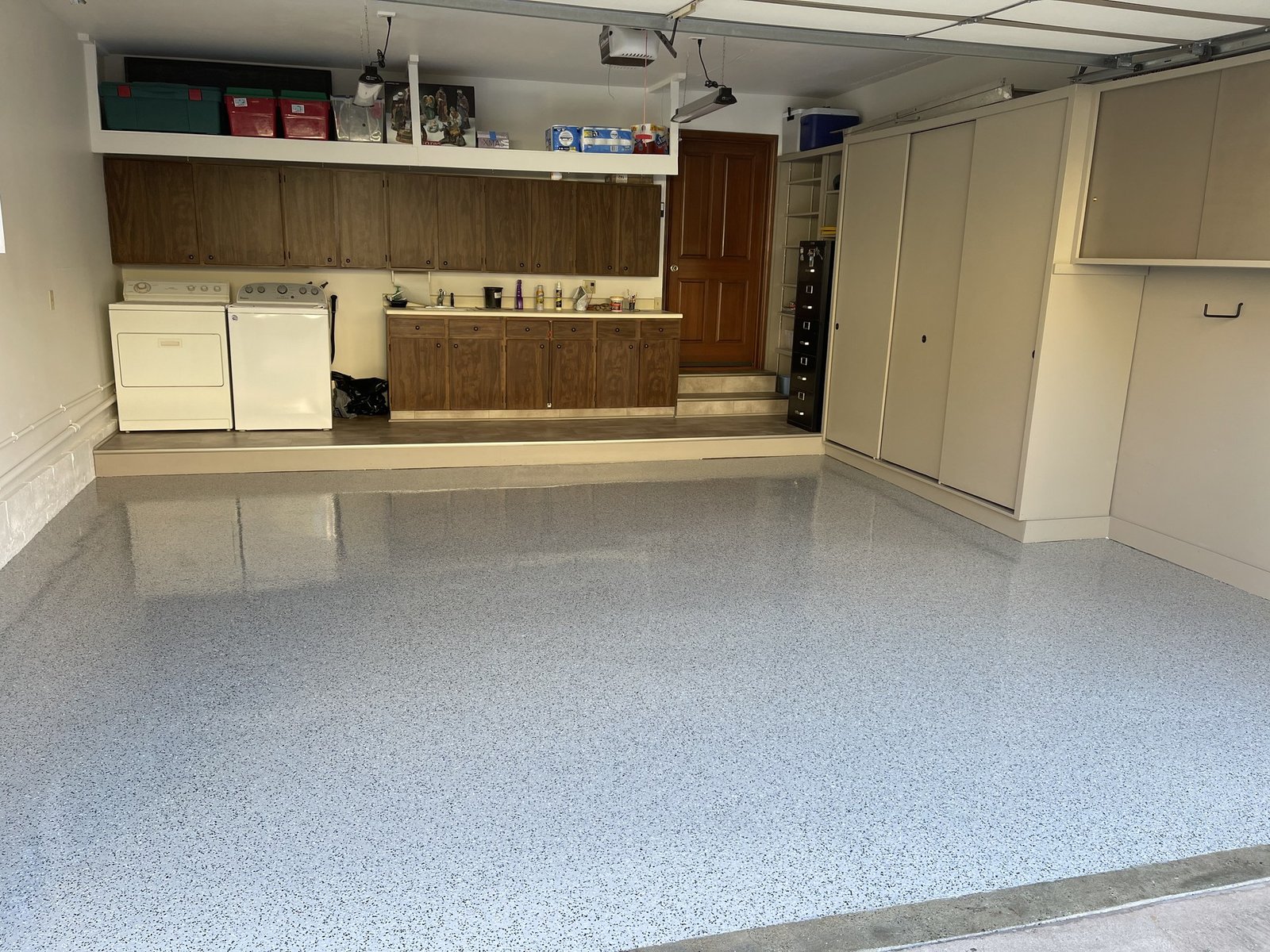
Solid-color epoxy is the value option: a pigmented 100%-solids epoxy body coat under a clear top. Epoxy ambers under UV, so it suits garages that stay closed most of the day. Flake epoxy with a polyaspartic top is our most popular garage floor epoxy system: an epoxy base for adhesion and build, full-broadcast vinyl flake, and a UV-stable polyaspartic clear that never yellows. Full-flake polyaspartic swaps in a polyurea or polyaspartic base, which cures faster and tolerates cold snaps and humid mornings at a higher material cost. Metallic epoxy is the showpiece, worked into a marbled, three-dimensional finish under a clear top.
| System | Best For | Build Thickness | Cure to Park | Estimated Price per sq ft |
|---|---|---|---|---|
| Solid-color epoxy | Budget garages, workshops, low-UV spaces | Approx. 20–30 mil | About 3 days | $4–$7 |
| Flake epoxy + polyaspartic topcoat | Most Franklin garages; best cost-to-durability balance | Approx. 30–40 mil | About 3 days (epoxy base governs) | $5–$8 |
| Full-flake polyaspartic | Fast turnaround, cold-weather installs, heavy use | Approx. 25–40 mil | 24–48 hr | $6–$9 |
| Metallic epoxy | Showroom garages and finished basements | Approx. 35–45 mil | About 3 days | $8–$15 |
Prices are Middle Tennessee installed estimates for a typical 400–500 sq ft two-car garage. Final pricing follows our on-site moisture test and slab inspection.
Torn between the flake systems? Most homeowners in Cool Springs and Thompson’s Station choose flake epoxy with a polyaspartic top. A full polyaspartic garage floor makes sense when you need to park within two days, when we install in January, or when the garage doubles as a workshop. Our full comparison of epoxy and polyaspartic base coats walks through the trade-offs system by system.
How the Two-Day Garage Floor Coating Install Works
Our standard residential install takes two days on site. Here is exactly what happens.
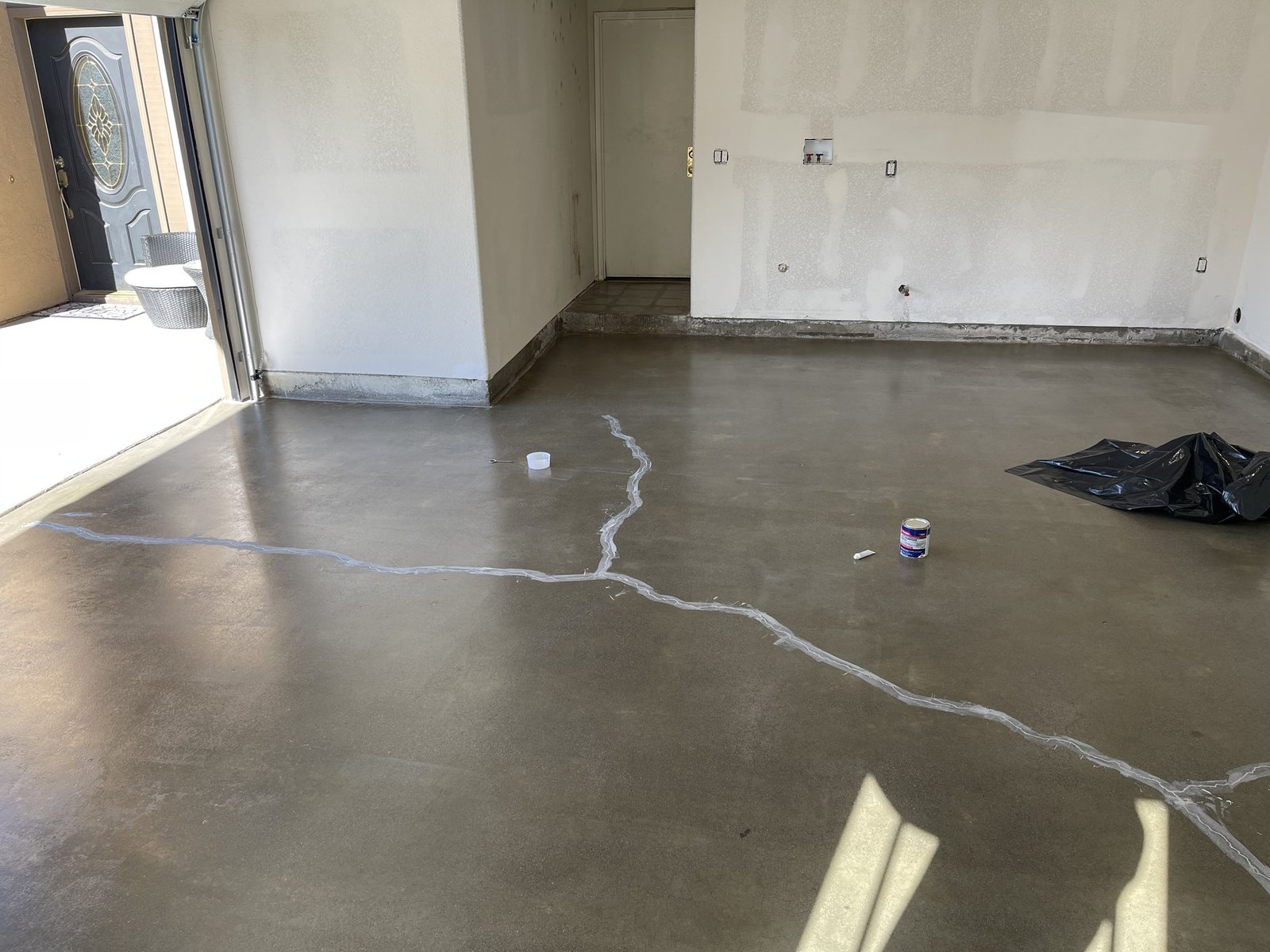
Day one starts with inspection and moisture testing. We walk the slab, note cracks, joints, pitting, and old coatings, and set calcium chloride or in-slab relative humidity probes to measure vapor drive. Then we grind: a planetary diamond grinder on a HEPA vacuum removes the cap, old paint, and contamination. Next we repair. Cracks are chased open, filled with fast-setting polyurea, and ground flush; control joints are filled; pits are patched. We then roll the base coat, 100%-solids epoxy or polyurea depending on the system, and while it is wet we broadcast flake to full refusal so no base color shows through.
Day two begins with the scrape. Once the base has cured overnight and locked the flake in, we scrape the floor with a flat blade to knock down flake standing on edge, then vacuum every loose chip. This gives a professional flake garage floor its smooth, even feel instead of the sandpaper texture of a rushed job. Then we apply the polyaspartic topcoat. You can walk on it in hours. Parking takes roughly 24 hr to 48 hr on a full polyaspartic system and about 3 days (72 hr) on an epoxy base, with full cure at about 7 days.
One-day systems compress this into one visit with a fast-cure base and no overnight bond time. We can install them, but you give up cure time and often build thickness, and we say so on every quote. It is the same discipline we bring to commercial epoxy flooring for shops and warehouses, where cure schedules are planned around a business staying open.
Why Middle Tennessee Garages Need a Moisture Test
Almost every coating failure we inspect in Williamson County traces back to moisture, not the product. Middle Tennessee slabs sit on clay-heavy soils over limestone, and that clay holds water. Nashville averages 50.51 in of precipitation a year, humidity averages about 70% and peaks near 74% in September, and the area records 67 days at or below 32°F and 49 days at or above 90°F each year, according to the National Weather Service Nashville climate summary. A slab that stays wet underneath and swings from freezing to 90°F pushes vapor up through the concrete, and vapor pressure lifts coatings from below.
That is why we test before we quote. Standard epoxy tolerates roughly 3 lb of vapor emission per 1,000 sq ft per 24 hr. Above that, or above roughly 75% to 80% in-slab relative humidity, we install a vapor-barrier primer that bonds through moisture and blocks vapor drive. It adds cost, and we would rather show you the reading than watch a floor bubble in spring. Weather dictates scheduling too: we do not coat within 5°F of the dew point, 100%-solids epoxy cures poorly below 50°F, and polyaspartic is what we lean on for cold or muggy days. This is a big part of why epoxy flooring in Franklin has to be approached differently than a coating job in a dry climate.
Garage Floor Coating Cost in Middle Tennessee
Searches for garage floor coating cost mostly return national averages that ignore local labor and slab conditions. For a typical two-car garage of 400 sq ft to 500 sq ft in Franklin, Brentwood, or Spring Hill, solid-color epoxy runs about $1,800 to $3,200. Flake epoxy with a polyaspartic topcoat runs $2,300 to $3,800. Full-flake polyaspartic runs $2,500 to $4,500, and metallic epoxy $3,600 to $7,500 depending on design complexity. National data from HomeGuide’s epoxy flooring cost guide lands in a similar range, a useful sanity check when comparing bids.
Add-ons are where quotes get murky, so we itemize every one. A moisture test is $50 to $300. A vapor-barrier primer, when the test calls for it, adds $1.50 to $3.50 per sq ft. Crack repair is $2 to $4 per sq ft of repaired area, not the whole floor. Coating the stem walls is $3 to $5 per linear foot. An anti-slip additive in the topcoat is $0.25 to $0.50 per sq ft. If you search garage floor coating near me and get three bids, ask which of these are included; the low bid often becomes the high bid on install day.
How to Prepare Your Garage for Coating Day
Preparation on your end is simple. Clear the floor completely, including shelving on the slab, and keep vehicles out through the install and cure. Sweep up loose debris, but do not pressure wash the day before; a wet slab slows us down, and the grinder removes surface contamination. Tell us about old oil stains, which sometimes need an extra degreasing pass. We need a 120 V outlet and a hose bib, and the garage door stays open most of both days for ventilation. Where the garage connects to the house, we tape off the door and lay drop cloths.
Maintaining a Coated Garage Floor
A polyaspartic-topped floor needs very little. Sweep weekly and wash with a neutral cleaner; routine solvent degreasers dull the gloss over time. In winter, hose off road salt before it sits for weeks, because salt crystals are abrasive under tires. Put a rubber mat under jack stands to spread point loads. With that care, our flake and polyaspartic systems typically go 10 years or more before the topcoat needs a refresh, which is a one-day job with no grinding to bare concrete. We offer a written warranty on residential garage floor coatings; ask for the terms when we quote.
If you are still deciding whether a coating belongs in your plans, our Williamson County epoxy floor guide covers basements, patios, and shops in addition to garages, and the Best Coast Epoxy Coatings home page lists every service we offer across Middle Tennessee.
Garage Floor Coating Near You in Middle Tennessee
We install epoxy garage floors and polyaspartic garage floor coatings from our base in Franklin across Middle Tennessee. If you are searching for garage floor coating near me, these pages cover your area in more detail: garage floor coatings in Nashville, Brentwood garage floors and Franklin epoxy flooring. We also cover Spring Hill, Nolensville, Thompson’s Station, Murfreesboro and Columbia.
For a full price breakdown by garage size, including every add-on, see our epoxy garage floor cost guide. For a showroom look, compare our metallic epoxy garage floors.
About the Installer
I am Ryan Pepple, founder of Best Coast Epoxy Coatings. I have spent 15 years installing epoxy and polyaspartic floors with my own hands. I built the company solo in Southern California, working out of Temecula and Murrieta, and now run it from Franklin, Tennessee, with a local crew. I personally inspect and moisture-test every slab before we quote it. We are licensed and insured, and we install our own work.
Garage Floor Coating Questions from Middle Tennessee Homeowners
Is a professional garage floor coating worth the cost?
For most homeowners, yes. A properly ground and moisture-tested system stops dust, resists oil and salt, and lasts many years, while a DIY kit typically peels within a season or two and has to be ground off. It costs more up front but is usually cheaper than doing it twice.
How long does a garage floor coating last?
A flake system with a polyaspartic topcoat over a diamond-ground, moisture-tested slab typically lasts 10 to 20 years in residential use, with a topcoat refresh along the way. We offer a written warranty; ask for the terms when we quote.
Should I choose a one-day or two-day garage floor coating?
Two-day is our standard because the base coat gets a full overnight cure before the flake is scraped and topcoated, which improves bond and build thickness. One-day systems work for tight schedules but trade away cure time and thickness. We explain both on every quote.
Can you coat over an existing epoxy floor?
Sometimes. If the old coating is well bonded, we sand it to a uniform profile and recoat. If it is peeling, thin, or went over an acid-etched slab, we grind it off and start from bare concrete. We test adhesion on site first.
How soon can I park on my new garage floor?
You can walk on a polyaspartic topcoat within a few hours. Parking depends on the base: about 24 hr to 48 hr for a full polyaspartic system, and about 3 days for an epoxy base, with full cure at about 7 days.
Does a coated garage floor help resale value?
A finished garage floor is one of the first things buyers notice from the driveway, and it signals a well-maintained home. We do not promise a specific return, but a coated garage photographs well and helps a listing stand out.
Are garage floor coatings slippery when wet?
Full-broadcast flake adds texture that improves grip over a smooth solid-color floor. For more traction we add an anti-slip aggregate to the topcoat for $0.25 to $0.50 per sq ft.
What do you do about cracks in the concrete?
We chase each crack open, fill it with fast-setting polyurea, and grind it flush before coating. Control joints are filled the same way. Crack repair is $2 to $4 per sq ft of repaired area, not the whole floor.
How much does it cost to epoxy a garage floor in Nashville?
For a typical 400 to 500 sq ft two-car garage, flake epoxy with a polyaspartic topcoat runs about $2,300 to $3,800 installed, solid-color epoxy about $1,800 to $3,200, and full-flake polyaspartic about $2,500 to $4,500. Our epoxy flooring cost guide covers one-car, three-car and basement floors.
What is the best garage floor coating?
For most garages, a flake system with an epoxy base and a polyaspartic topcoat over a diamond-ground, moisture-tested slab. It bonds well, hides imperfections, adds grip, and the topcoat resists hot tires and UV. A full polyaspartic system is best for fast turnarounds and cold-weather installs, and metallic epoxy is best for a showroom look. The best product still fails without proper prep.
Ask anything else at (615) 807-0582 or hello@bestcoastepoxycoatings.com, or read how our crew approaches polyaspartic floor coating for garages and shops and warehouse and retail epoxy floors across Middle Tennessee.
Get a Transparent Garage Floor Coating Quote
We serve Franklin, Brentwood, Spring Hill, Nolensville, Thompson’s Station, College Grove, Arrington, Fairview, Cool Springs, Nashville, Murfreesboro, and Columbia from our base in Franklin. Call (615) 807-0582 or learn more about our Franklin epoxy flooring services before you call.
Call (615) 807-0582Request a Free Floor Quote
Tell us about your floor and we will reply with a price range and a date for a free moisture test. Prefer to talk? Call (615) 807-0582.